
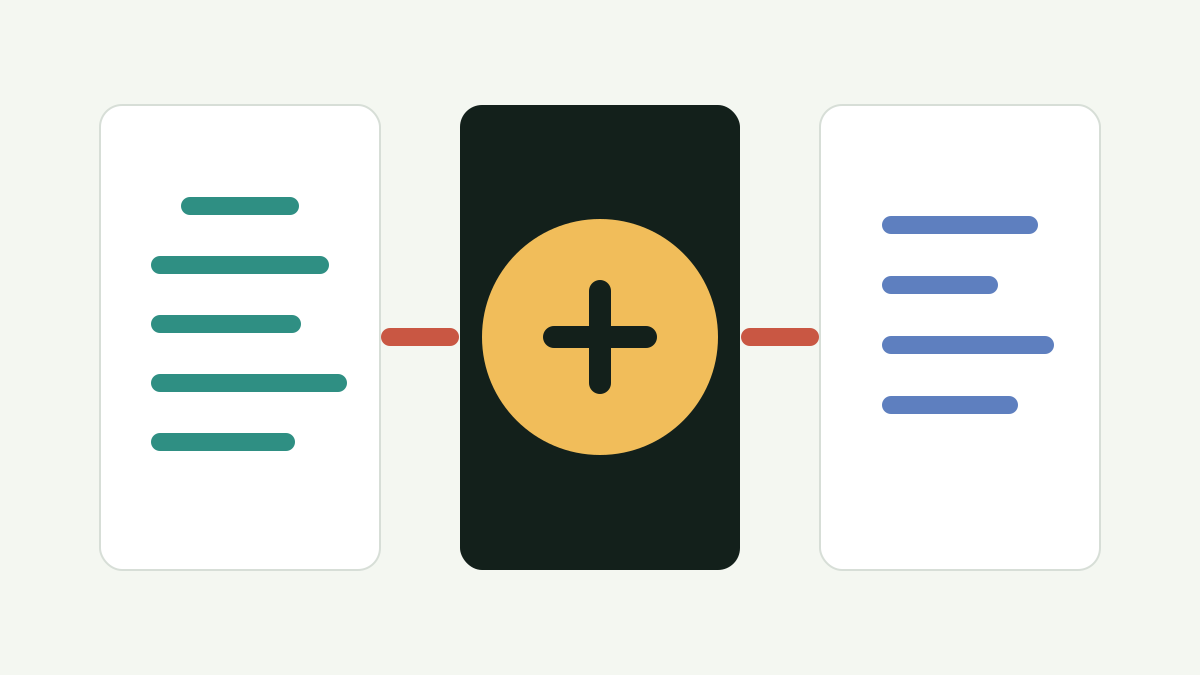
Retrieval augmented generation, often shortened to RAG, is becoming a default architecture for healthcare knowledge tools. Instead of asking a language model to answer only from its internal parameters, a RAG system retrieves relevant source documents and asks the model to synthesize an answer from that context.
That sounds simple. In healthcare, the details matter. RAG can improve traceability, but it does not automatically make a system accurate, current, or safe for clinical use.
The Main Benefit Is Auditability
RAG gives teams a way to connect generated text to source material. This matters for clinical policies, benefit explanations, prior authorization support, pharmacovigilance workflows, and medical affairs content review.
When the retrieved sources are visible, reviewers can inspect whether the answer is grounded in approved material. That is a meaningful improvement over a generic chatbot response with no evidence trail.
Retrieval Quality Becomes the Control Point
The model is only one part of the system. The retrieval layer determines which documents are available, how they are chunked, how freshness is handled, and how conflicts are resolved.
Teams should test retrieval separately from generation. If the right document is not retrieved, a polished answer can still be wrong. If outdated guidance appears next to newer guidance, the model may blend both unless the workflow gives it clear instructions.
Source Governance Is Product Governance
A healthcare RAG system needs a governed corpus. That means document owners, update schedules, retirement rules, access controls, and audit logs. A knowledge base with unclear ownership will eventually create unclear answers.
For regulated or high-impact workflows, the source library should be treated like a controlled product input. Teams should know which documents are approved for model use and which are excluded.
The User Interface Should Expose Uncertainty
RAG products often hide uncertainty behind confident prose. A better interface shows citations, timestamps, retrieval coverage, and limits. When the system cannot retrieve enough relevant material, it should say so.
This matters because users may treat fluent text as more authoritative than it is. Design can either increase that risk or reduce it.
Evaluation Needs Real Questions
Generic benchmark results are not enough. Healthcare teams should test with realistic questions, local terminology, expected edge cases, and known ambiguous scenarios. The evaluation set should include questions where the right answer is to escalate, refuse, or ask for more context.
The strongest RAG systems are not just better at answering. They are better at knowing when the available material is insufficient.
RAG Is a Governance Pattern, Not a Shortcut
RAG can make AI knowledge tools more transparent and easier to review, but it does not remove the need for human oversight. Its value comes from disciplined source management, retrieval testing, careful interface design, and clear workflow boundaries.
For clinical and life science teams, the best early use cases are usually internal knowledge workflows where source control is strong and the system can be evaluated before it affects patient-facing decisions.
Join the discussion
Be respectful and stay on topic. Comments with offensive language are held for moderation. This is not medical advice.